
The Use of the Useless
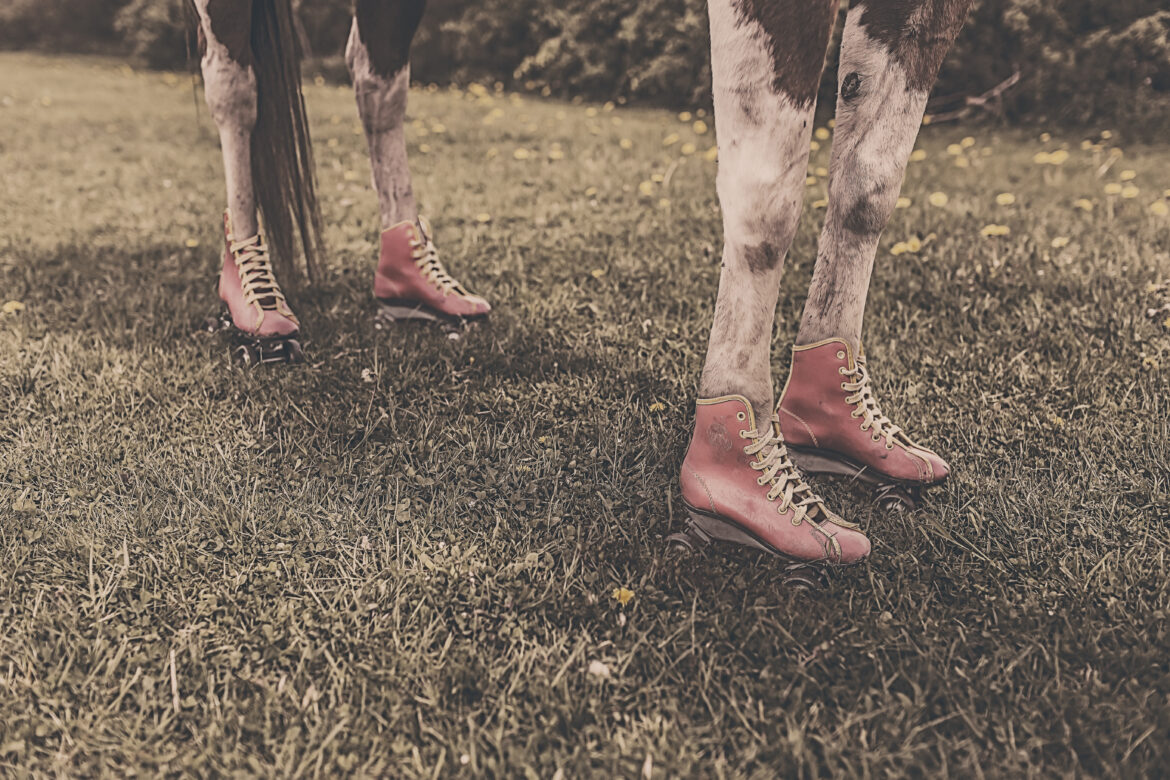
“All men know the use of the useful, but nobody knows the use of the useless.” ~ Zhuangzi
The farmers where I live collect huge piles of tumbleweeds and set them alight in spectacular blazes on mornings before the wind takes hold. Their thorns pop like bang snaps before they turn to ash and you’ve never seen anything go from existence to non-existence that quick. They’re fire hazards that way and in much of the West they are considered a noxious weed. Invasive. Not of here, having hitch-hiked to the U.S. with flax seeds during the 1870s.
I let them build up like a spiny fortress against my arena fence. Once in a while I dance with them before I set my horses loose in the arena. And by dance, I mean I kick them loose with my muck boot, hold them gingerly by their bases, then toss them to the fence line so my horses don’t have to tango with them as they run and buck and try to injure themselves on nothing whatsoever as horses are wont to do. Later, a baby jackrabbit shelters beneath them, hidden from the red-tailed hawk circling overhead.
In the spring, does heavy with fawns eat their young green shoots, before they turn barbed and bitter.
Few know of their value.
But my 93-year-old uncle knows. A lifelong rancher and the epitome of a cowboy to the very tip of his bolo tie. He tells me how he planted one year, before the snow came heavy. The tumbleweeds had blown in and laid down over his field like a blanket and his seedlings germinated and sheltered under them in the same way native seedlings still germinate under tumbleweeds today. Botanists call it a nurse plant.
His harvest thrived and his cattle got fat off the tumbleweeds, leaving his crop to grow. Turns out, tumbleweeds are full of protein.
Even fewer know how they helped to save the cattle industry when the Dust Bowl stripped the land bare, the wheat failed, and those useless tumbleweeds were harvested to create thistle hay. In Kansas alone, farmers harvested 350,000 tons in 1934 to feed their livestock. After wildfire, they’re the first thing holding the burned ground down, trapping moisture and feeding the soil they’re accused of ruining.
I marvel when they blow across my land, one of nature’s most inventive means for seed dispersal.
The overculture measures the tumbleweeds by ROI and finds none. But when the earth measures, she finds them invaluable.
I’m invasive too. Not of here. Born to pioneer women. A man-handed, three-titted (we’ll get to that) woman who dons a clean gray shirt each morn and looks like Pigpen by dusk.
I’ve lived my life like a tumbleweed. It must be my spirit plant. My roots have been so shallow at times that tough winds blew me across the country. I left a good marriage because my blood stopped coursing there and I traveled back east with thirty boxes of books and a twin mattress. I roll about collecting wisdom from every misstep I’ve ever made. It all lives inside of me, in my brittle arthritic bones that farmers might toss on the burn pile, too.
I blew back home a decade later, a few more boxes of books in tow, and settled in a valley below Dry Creek and, just like the tumbleweed, decided to offer cover for “useless animals.”
Each night before bed, I go out to check on one of my colonies of feral cats. Many were dumped out here “in the country.” Some seriously injured. Some as kittens left near a culvert on the side of the road. Scrawny little things, their eyes thick with sludge, cajoled with a can of prime filets into traps so they could be fixed and released back here on the sanctuary.
When I open the door one night, my cats are nowhere to be found and a raccoon waddles past before pausing to look back at me. We hold eye contact for a few minutes before she lumbers down my stairs. I can feel the silent agreement.
I see you.
And I see you. Her backside is twice the size of her front. It reminds me of my dowager’s hump.
“You’ll find refuge here. And water and Friskies.”
After all, we’re both trying to eke out our existence in this high desert drought. The air riddled with smoke from one of our many wildfires. We had no winter. The least amount of moisture measured since they began measuring one hundred and thirty-ish years ago. It’s so hot and dry, in fact, that my annuals came back. Little pansies poking up out of the dirt in scattered places shouting, “Mr. Bill, Mr. Bill” as they wave their little frond arms in the blow-dryer breeze.
Raccoons aren’t native either. Many call them invasive. But I imagine a bunch of burly men in their dusty Ropers bringing that raccoon’s ancestors here, against their will, because they were keen on training their coonhounds. Damned if those coons didn’t outsmart and outmaneuver both man and beast, and those masked critters—whose closest relative is the bear—downright thrived.
I do wonder how many will come.
Too many will come.
The Native Americans whose land I live on surely felt this way about my pioneer ancestors.
The night after our silent agreement, the raccoon brings her three babies. And the next night. And the next.
When I ask my neighbor about them, ever-so-slightly worried about the rabies everyone seems hellbent on warning me about, he says it’s illegal to trap and relocate them. They have to be “dispatched.”
The word “dispatch” lodges in my mouth, clogging my throat and choking me like the alginate dentists use to make teeth molds before it hardens.
By all measures of the “standard horse industry,” my horses would be called “useless.” Too old to “do a job” or “make me money.” After all, I can’t breed them, race them, or sell them. Rio, my palomino, was abused because the previous owner didn’t know he can’t see much but shadow behind either shoulder. Julio, named after Julio Iglesias, was set to take a trip to Mexico on a meat truck because he had severe laminitis. The vet gave me a 50/50 chance of reversal six years ago.
There’s no use for the useless. Around here, folks squeeze out the drops of a horse’s youth and marvel over their powerful flanks and when they see that it takes their horse just a few beats longer to get up after they’ve rolled, or they’re not as quick-moving on the trail with their cattle, or their back is starting to sway or their knees have a bit too much arthritis, they get rid of them. Most horses don’t get a sweet retirement. They’re replaced by the younger, the stronger, and the quicker.
And so it goes for roosters, too.
My rooster, Niles Cogburn Crane, was attacked by a dog when he was but a babe. In fact, “his” name was originally “Nelle.” That is, until he crowed. No one wants roosters. They don’t produce eggs. Where I live, folks set them “free” in fields to fend for themselves with no food or water. Once a year, our town has an “animal scramble” before the rodeo and kids chase after all manner of creatures and then a few days later toss them aside along with the paper cone from their cotton candy. If I had a tick for every time I’ve heard the phrase, “my animals have to have a job and earn their keep,” I’d have Lyme disease.
I go to the dermatologist and out of the blue he asks what I believe. We talk about the work of Carl Jung, of quantum physics and stardust, of shadow and light. He brings up a scripture about sons and sunrises. On the way to his office, I’d been grappling with a Hindu text about the senses that I’m torn over. But then, because there is a great Trickster always making ripples in the pond of my life, the doc tells me that the mole I asked him to check is actually a third tit. (My words, not his.)
“Excuse me?”
He leans against the med cabinet and folds his arms as he says, “It’s a mammary ridge. Also known as milk lines. They’re not uncommon, but people mistake them for moles.”
“What?”
But then a knowing. I’ve been caring for animals for so long that I’m becoming one of them. I of the animal body with a useless third tit. “Line those puppies up. Bring me all your ‘useless’ creatures. I’ll feed them.”
I once told my spiritual mentor that I didn’t want to be enlightened. I felt like an ignoramus saying such a thing to him of all people—this person I admire and aspire to. But I could feel some truth of it in my bones. And I think I understand now why I said it. In the world of spirit and matter, matter isn’t supposed to matter.
I get it. This dream is living me. Materialism is on its way out (for some), but what happens when the pendulum swings ALL. THE. WAY. to the other side?
Yet I wonder. Was I enlightened before I came here? And will I be enlightened after I go? But the in-between. The now:
I signed up for it on the dotted line.
I cashed the check.
I bought the farm. Literally and figuratively.
To feel the grief and crumple onto my horse, my sweet Leroy Boy, as he received a lethal injection because his coffin bones were growing through his soles. He was in too much pain to hold his 1,100 pounds on his dainty rope-bred feet. It was love, not loss, that wrung the grief from my eyes. My tears poured for three days, even in moments I wasn’t thinking about those last few minutes of his life.
And I think there’s something more. In the world of the spiritual, only spirit is supposed to matter. It reminds me how for thousands of years the masculine was what mattered. Spirit. Not matter. But what is matter? Mater. Mother. The feminine. The body that ages and decays. We have no value for it. Some think one day we can outsmart it. They’re sure as hell trying.
To ask me to transcend my senses is akin to asking me not to bury my face in Julio’s neck and breathe in Horse. My sister-in-law often tells me I stink like horse, and when she does, I sniff my own gray shirt just to smell it on me with its notes of Grandpa and its hints of grit. I’d bottle it, if I could.
I write down the word entanglement on a piece of paper, and a tiny spider skitters across the page. It crawls down into the bottom of the three rings and disappears. I write the word entanglement again and he skitters back across the page.
It’s glorious to live in this mundane and mystical world full of matter. To feel the pressure from Rio’s flared nostril, to smell the peonies bending with their giant pink blossoms, to hear the rain pattering on the barn roof as I muck the stalls. I “see” God the day I question her existence in the deer picking its way through the tumbleweeds in my back field. She reminds me, “gently, gently, gently.”
I might still say that I don’t seek enlightenment so much as I seek to lie on the warm belly of earth. I measure that warmth, feeling the pebbles grind against the back of my head, and hear the aspens clattering overhead like thin wooden bells. I’d mortgage my soul to buy the farm, again and again and again.


Leave a Reply
Want to join the discussion?Feel free to contribute!